Getting Going with Oral Labour History Seminar 3 June

Britain at Work (B@W) 1945-95 in association with British Universities’ Industrial Relations (BUIRA) IR History Group and Oral History Society (OHS)

Saturday 3 June 2017 11am-4.45pm

Once again, the Britain at Work (B@W) group is organising an Oral Labour History Day. This year’s theme is about how to get going and continue with oral labour history, with examples from different projects and inspiring presentations from those engaged. The day begins with an opening address To Start You Talking by Alan Dein, oral historian and radio documentary presenter, who will reflect on his personal archive of inspirational storytellers – interviews that often began by just stumbling upon a story out of the blue. Then follow round table introductions on projects in which symposium participants are involved. After lunch, there will be presentations concerning inspiring projects by the trade unions, BECTU and CWU, and by Glasgow University on the 1984/5 Miners’ Strike. The day will end with a Robert Wilkinson from the Walthamstow History Workshop who is an expert at obtaining funding and running projects. All those engaged in or with an interest in oral labour history, and particularly trade unionists, are welcome to participate.

B@W is an initiative to capture the memories of people at work between 1945 and 1995, some of which are to found at the TUC Library Collections held at London Metropolitan University (www.unionhistory.info/britainatwork).

University of Westminster, 35 Marylebone Road, London NW1 5LS
(opposite Madame Tussauds and nearly opposite Baker Street tube)
Room C279 (lunch C287)

For further details or to reserve a place, please email Michael Gold (m.gold@rhul.ac.uk) or Linda Clarke (clarkel@wmin.ac.uk)

Programme:
10.30-11.00 Registration
11.00-11.15 Welcome and Introduction: Linda Clarke
11.15-12.00 Keynote: Alan Dein,To start you talking, broadcaster and oral historian (chaired by Linda Clarke)
12.00-13.00 Roundtable: Brief contributions from participants (if they wish), on who they are and their interest in oral labour history (chaired by Michael Gold)
13.00-14.00 Lunch: Room C287
14.00-15.00 Presentations (chaired by Ann Field)
· Mike Dick (BECTU, media and entertainment trade union)
· Norman Candy (CWU – Communication Workers Union)
· Diarmaid Kelliher and Johnnie Crossan (Glasgow University: 1984/5 Miners’ Strike, Kent)
15.00-15.30 Discussion (chaired by Ann Field)
15.30 Break
15.45-16.30 Robert Wilkinson (Walthamstow History Workshop) on Heritage Lottery Foundation – how to apply (chaired by Joanna Bornat), followed by discussion and questions.
16.30-16.45 Closing observations (chaired by Joanna Bornat, Oral History Society)
Kieran McGovern and the Mallow Shootings of 1921 – Part 1

Author Kieran McGovern

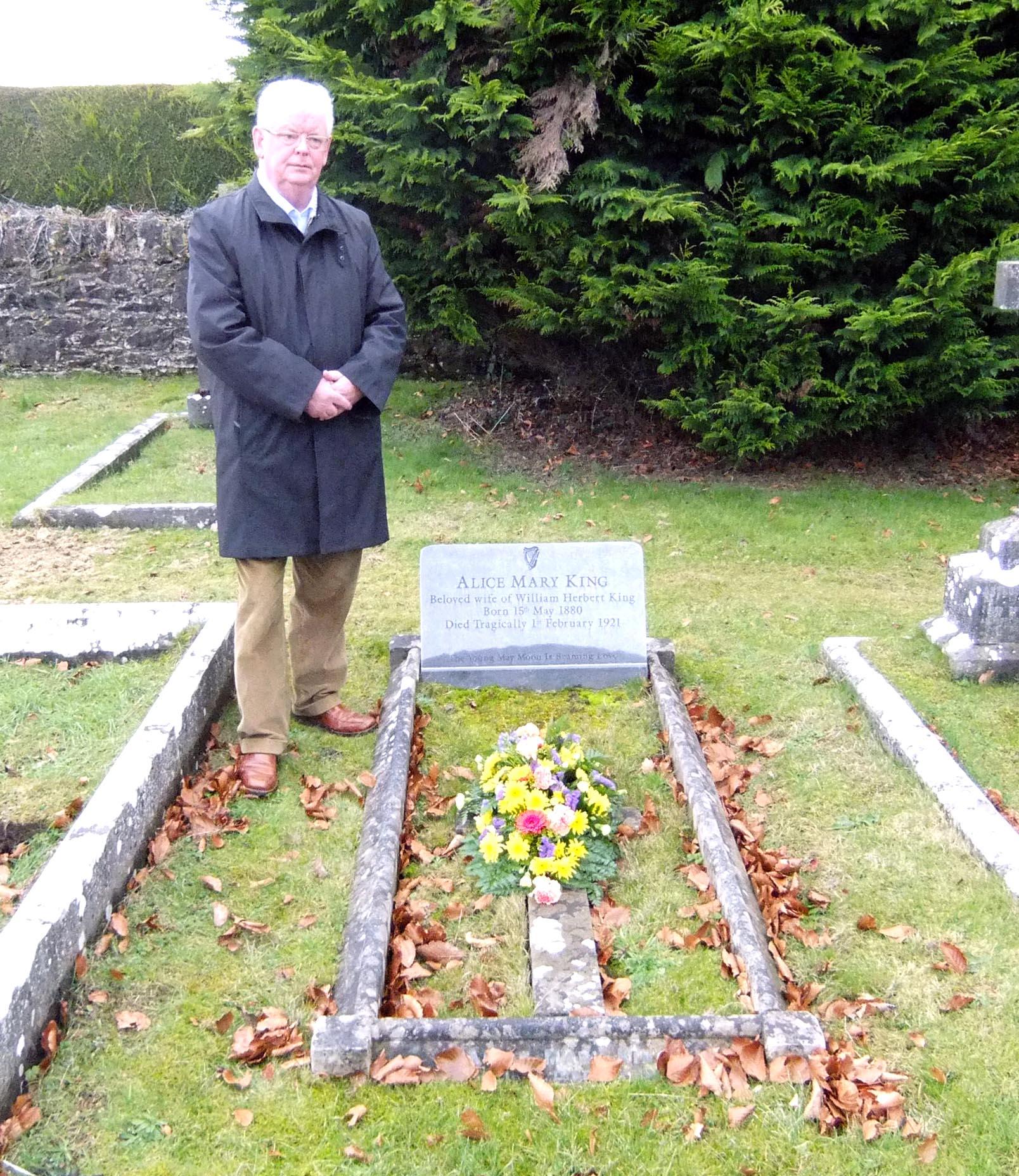
Kieran McGovern by the grave of Alice King (copyright the author)

Kieran McGovern, a retired conciliation officer and adjudicator, is our guest blogger this week. His research into the murder of railwaymen in 1921 led him to the TUC Library and a report entitled An Account of the Mallow Shootings (January 31st 1921) published by the National Union of Railwaymen (London). This is part 1.

Most of my work was spent in the Mid-West and South Regions of Ireland, an area of intense military conflict during the Irish War of Independence of 1919-1922. Many desperate deeds took place throughout the area during a time also known as “The Black and Tan War”. Not for nothing was it known as “The Rebel Region” – as the many roadside memorial and graveyard headstones throughout the counties amply testify.

In the course of my work, mention had been made in passing of an episode in which a number of railway workers had been shot dead and others wounded at Mallow Railway Station on 31 January 1921. Trade Unionism and comradeship ran deep throughout the region; “militancy” in industrial relations matters had not fallen too far from the tree of independence, so to speak.

During a previous research project I had encountered a Nora Lloyd,  living in London, and in our correspondence Nora mentioned that her aunt, Alice King, had been shot during the Irish War of Independence. Nora had written a novel, “The Young May Moon” (T. Nelson & Sons; 1935), which was loosely based on the event. Imagine my surprise to discover, after much research, and by pure happen-chance, that the shooting dead of Alice King had taken place at Mallow Station and that it was as a direct consequence of her shooting that the railwaymen, of whom I had heard about previously, had also been shot dead and wounded. Much further research, over a protracted period of time, gave rise to my discovering the unmarked grave of Alice King in Saint Gobnait’s Graveyard, Mallow. Eventually, on the day I visited the graveyard for the first time to find the spot where she lay buried, the caretaker was able to dust-off and search his large Dickensian-like record book and bring me to the precise spot. He told me, quietly and reverently as he pointed to the overgrown rectangle of earth, surrounded as it was by a low granite plinth, that he, and his caretaker-father before him, had often pondered who had been buried in that one single unmarked and unattended grave and why no one ever enquired about it. They knew, nearly personally, something about every other grave in “their” cemetery – but not this one. But now, with my arrival, the mystery of the grave was solved for them as it was for me. The man was genuinely near to tears as he listened to the tale.

With the passage of time Nora had unfortunately passed away and her daughter, Bridget (living in London), had joined me in our common search. Bridget, along with a number of other descendants and relatives across the globe all concluded that a marker stone would have to be erected on what, until then, was thought to be an unmarked grave. In the meantime, having visited Mallow a few times, I had tidied up the grave area and had discovered a crucifix-shaped stone that had fallen and lay virtually invisible and overgrown on the grave; it was a simple headstone that had been erected for Alice over eighty years before.

Acting on behalf of Bridget and in consultation with the diasporadic Patten/King descendants, I had a grave marker made locally and erected. Bridget and her extended group came to Ireland and we all joined in a ceremony at the graveside. It was a moving, yet memorable, occasion. This including local encouragement inspired me to write a book and so I set about the task with enthusiasm, building on material already collected.  On my visits to Mallow I had met many who knew of the event. I read all the relevant Witness Statements (these were written in the 1950’s, by participants, but embargoed until all were deceased) held in the Irish Bureau of Military Archives. I followed up on leads by studying archives at the Irish National Library Manuscript Department, at Kew in London and at many, many other repositories. All available contemporary newspaper reports (Ireland, U.K., USA, Canada, Australia, New Zealand, S. Africa, France, etc.) were searched in detail. 

Part 2 next week.

Workers’ Educational Association featured in new book about Citizenship

Co-editor John Griffiths writes about the publication, having spent time researching in the TUC Library.

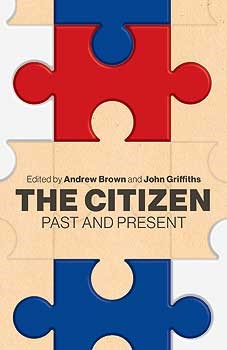
The new book titled The Citizen: Past and Present has been published by Massey University Press, New Zealand. (2017), and contains 11 chapters, the last of which focuses on the history of the WEA as an association for the promotion of citizenship in the 20th/21st century.

Cover of new book

Quite how citizenship has been defined at points across time and whose agenda lies behind the notion of citizenship is discussed in chapter 11 by co-editor John Griffiths, Senior Lecturer in History at Massey University. For his chapter titled From Citizens to Dilettantes and Back Again? The Workers’ Educational Association and its Students Since 1945 John explored the archive of the WEA, held within the TUC archive. He used annual reports (1945-) of the Association’s districts, the Association’s journal The Highway, various pamphlets written by WEA administrators which contemplated the Association’s objectives and purpose and the many volumes written about the WEA since its inception, also held in the TUC archives.

WEA publication

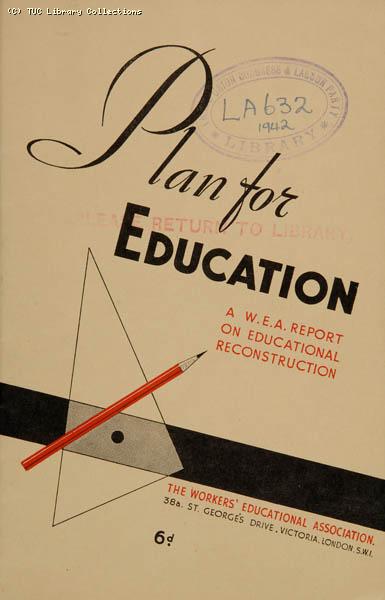
The Plan for Education, published by the Workers’ Educational Association in 1942, outlines their proposals for the restructuring of educational policy after the war and includes a special appendix on agriculture and rural education.

The Association had prided itself in the years before World War II in preparing students for active citizenship in areas such as local government, parish council, school and hospital governance. Several members of the post 1945-Attlee government (1945-51) had connections with the WEA. After 1945, if not before however, it was noted by several observers that the Association was becoming more dilettante, in that those taking WEA classes were more middle-class than working-class and ‘education for social purpose’ was being diluted. This concerned the Association for at least the next three decades.

A change in direction was noted in the 1970s as the WEA also began to offer education for the socially disadvantaged – known as ‘Russell type work’ – taking its name from the report into adult education of 1973, headed by Lionel Russell. This work was seen as more socially relevant and by the later 20th century placed the WEA in a position as a significant organisation for offering citizenship and social inclusion which chimed with New Labour’s objectives (1997-2010), particularly the introduction of citizenship instruction in schools. This chapter sits alongside other contributions which examine what citizenship has meant at points across history, from the very early civilizations to the modern day.

The Clarion Van – Margaret Powell remembers her grandfather

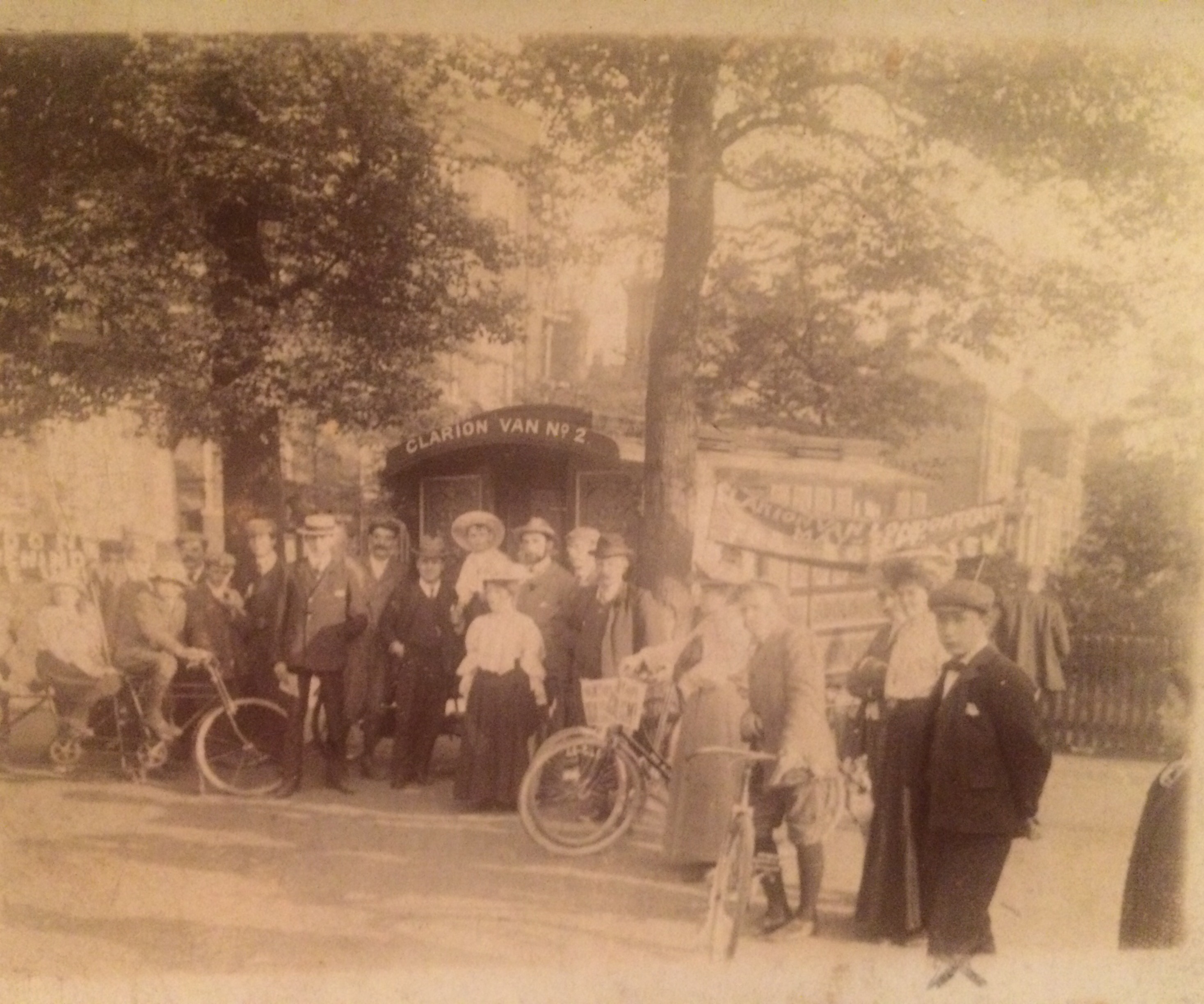
Joe Tarrant, Margaret Powell’s grandfather, stands to the right of the Clarion Van (marked with a cross. Thank you to Margaret Powell for her permission. Copyright Margaret Powell )

We have a guest blog post this week from Margaret Powell who very kindly sent this fantastic photo in to us of her grandfather, Joe Tarrant. I asked her for more information and what the banner says. She wrote –

The banner says Clarion Van London Tour – May, but I can’t make out the year. My granddad, Joe Tarrant, 1885-1980 was a keen cyclist all his life. He looks very young on here, so I imagine it’s about 1900. He lived at Barnardo’s homes from the age of 19 months, but went back home(to London) when he was about 14, presumably because he was of working age, so I don’t think we can date it before then. I have been reading about the Clarion movement online and it makes interesting reading. Granddad moved to Bristol for his work as a tinsmith and later to Liverpool. He was always involved in the tobacco industry as far as I know. (Wills and the British American Tobacco Company).

We have a few more photos and publications about the Clarion in the TUC Library (see below).

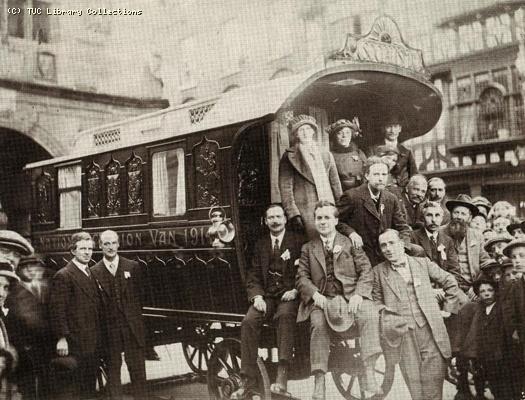
Later period Clarion Van, 1914 (Copyright TUC Library Collections.

Robert Blatchford founded ‘The Clarion’ as a weekly Socialist newspaper. Clarion readers organised various activities e.g. cycling clubs, choral societies, rambling clubs, often meeting in Clarion club-houses. The Clarion Vans were mobile propaganda vehicles, carrying Socialist leaflets, newspapers and speakers to rural areas, often accompanied at weekends by “Clarionettes” on bicycles. This photo shows the dedication of a new National Clarion Van designed by Walter Crane, at Shrewsbury on 12 April, 1914. Fred Bramley (TUC General Secretary 1923-1925) is seated, holding hat, at centre of the photograph. Clarion Vans continued touring until 1929.

Unveiling of Blue Plaque in honour of Mary Macarthur

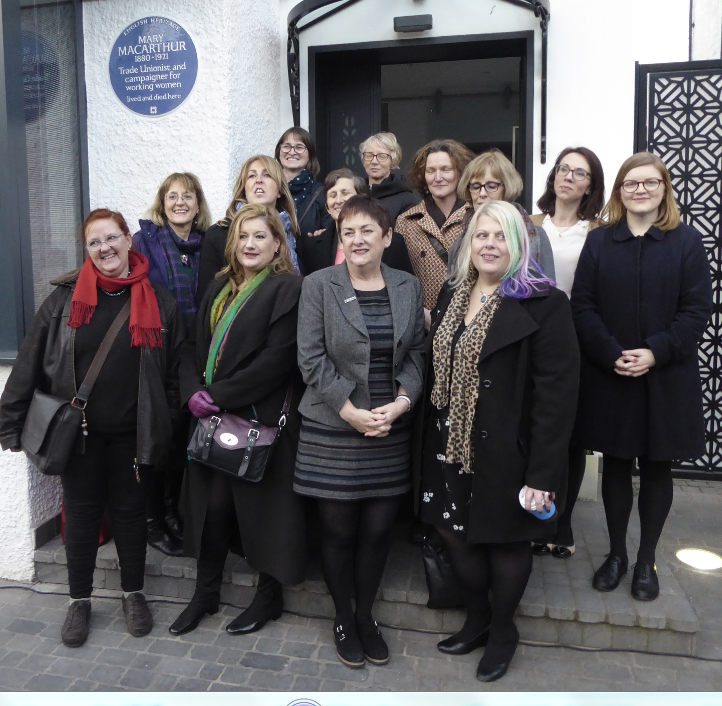
TUC Women’s Committee at the unveiling ceremony

The TUC Library attended the unveiling of an English Heritage Blue Plaque in commemoration of suffragist and trade unionist Mary Macarthur at her former home in Golders Green (42 Woodstock Road) last night. The day was chosen because it preceded International Women’s Day and the start of the annual TUC Women’s Conference.

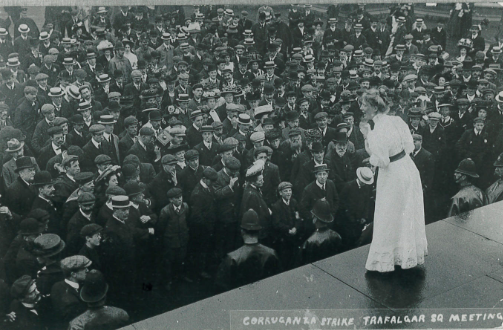
Mary Macarthur (13 August 1880 – 1 January 1921) was the general secretary of the Women’s Trade Union League and was involved in the formation of the National Federation of Women Workers and National Anti-Sweating League. In 1909 Mary led the women chain makers of Cradley Heath to victory in their fight for a minimum wage and led a strike to force employers to implement the rise. Speeches were made by, Mary Bousted TUC President, Vicky Knight, Chair of the Women’s Committee and James Deane, Mary’s grandson.

The TUC Library has a number of collections relating to Mary Macarthur.

Mary Macarthur speaking at a rally in Trafalgar Square about the box makers strike Aug 1908, Corruganza, Tooting London


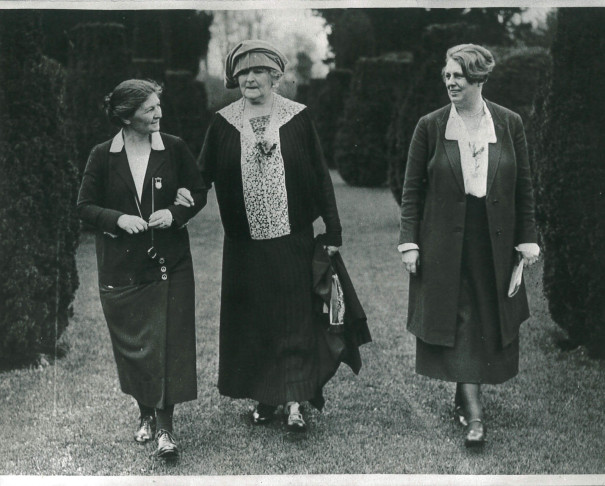
Mary Quaile, the TUC and Easton Lodge, 1926

  Margaret Bondfield, Countess of Warwick and Mary Quaile in grounds of Easton Lodge


Margaret Bondfield, Countess of Warwick and Mary Quaile in grounds of Easton Lodge

Guest post from the Mary Quaile Club https://maryquaileclub.wordpress.com/
History, activism and discussion in the Greater Manchester area @MaryQuaileClub

In 1924 Mary Quaile was elected onto the General Council of the TUC, and with Julia Varley attended the National Conference of Labour Women, a conference of International Women Trade Unionists in Vienna and the Third International Trade Union Congress.

At home she now took part in delegations to lobby government ministers on issues including the Labour Government’s unemployment policy. In 1925 Mary was again elected onto the General Council. In 1926 Mary did not stand again for the General Council, but she continued to attend Congress as a delegate from the TGWU until 1931.

Recently we have come across pictures of Mary at the official handover of Easton Lodge to the trade union movement as a working class college. Ironically, a house maybe not that different from where she got her first job as a domestic.

Easton Lodge was owned by Countess Warwick (1861-1938) who, by 1926, had been a member of the socialist movement for over 25 years. It was an era in which a Countess standing as a prospective Labour candidate was not seen as bizarre!

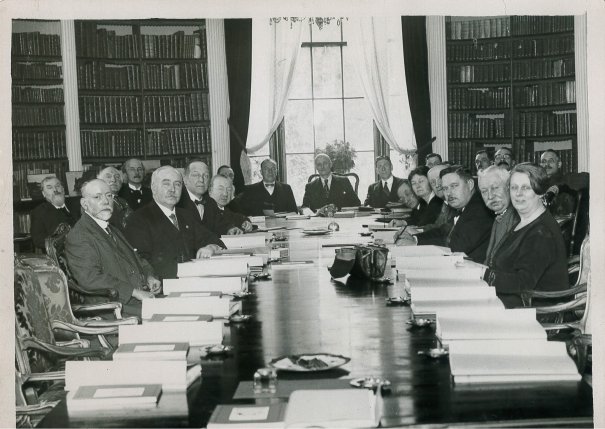
TUC General Council with Mary Quaile on the right  on the right

TUC General Council with Mary Quaile on the right on the right

In 1926 Countess Warwick handed over the historic building and sumptuous park and grounds to the General Council of the TUC who paid a visit. It was dubbed “Labour’s Chequers.”

(Photos from the TUC Library Collections)

Material on wages in the TUC Library Collections

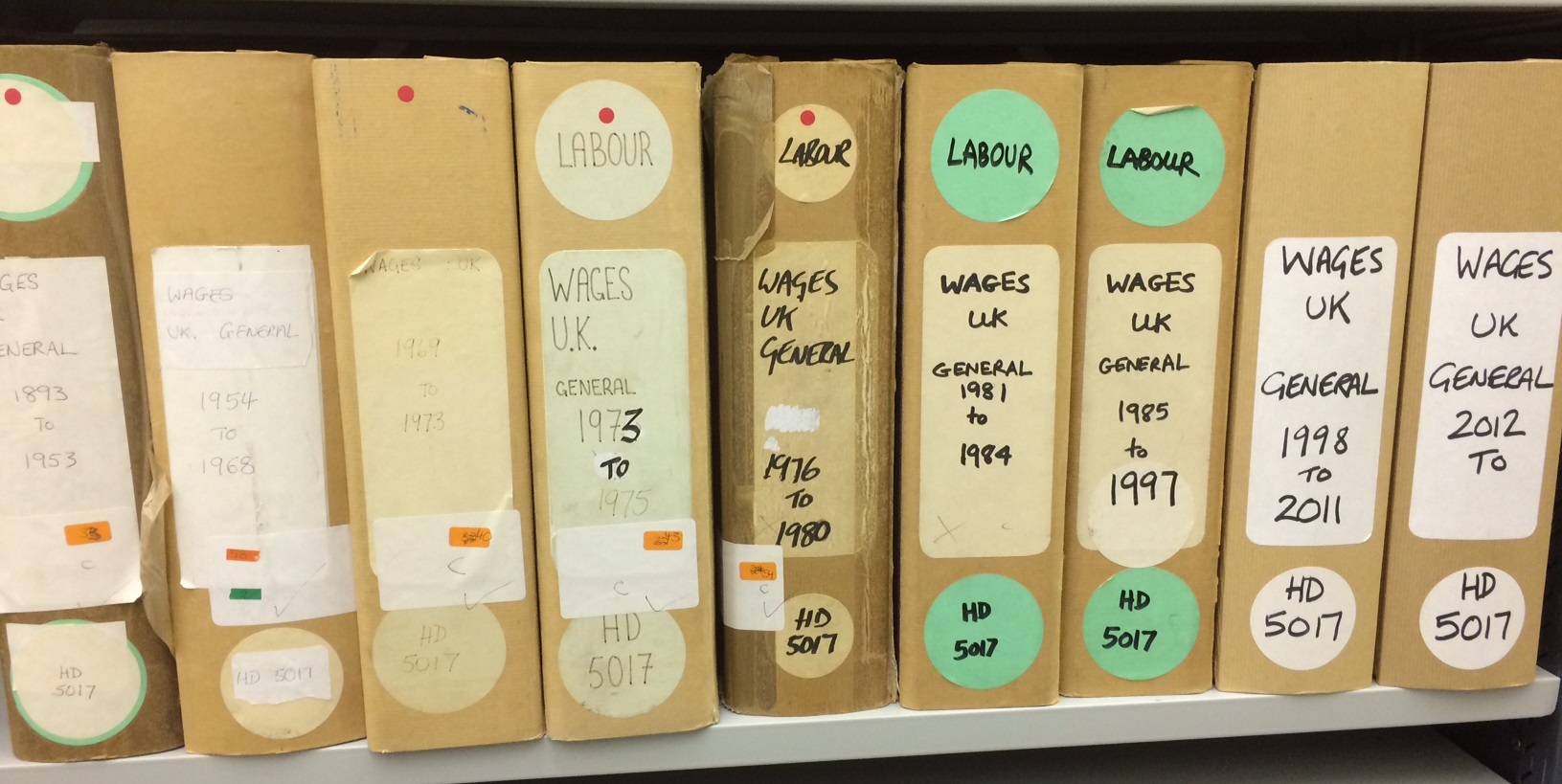
A selection of boxes on the subject of wages, from 1893 to the present.

The New Year has seen a number of news stories about wages in the UK – from the High Pay Centre’s statistics that by 4th January 2017 CEO’s had already amassed the same wages as the average Briton’s salary for the whole year, to Labour leader Jeremy Corbyn’s call for a maximum wage cap.

The TUC Library contains collections on Britain’s wage rates since the late 19th century, as can be seen in the photo above which shows just one of our many shelves on the topic.

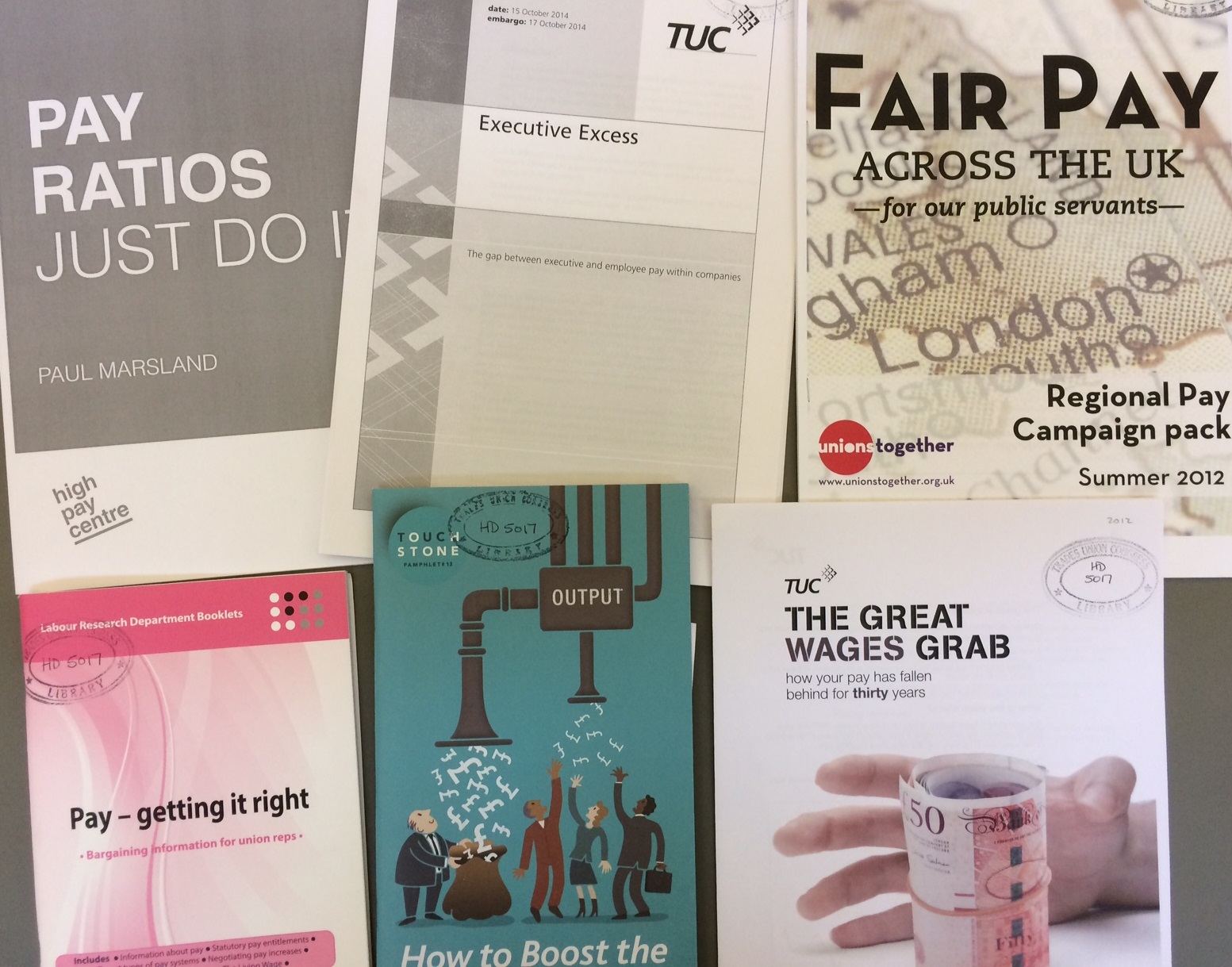
We also have contemporary material from the High Pay Centre, the Low Pay Commission, the Incomes Data Service and a broad range of think tanks, charities, government departments, academic studies, and of course from the TUC and unions.

A small selection of recent publications on wages

To find out more about what the library contains on this or any other topic, or to arrange an appointment to visit, get in touch.